
Upgrade Your Home with a Tankless Water Heater Install Today
Tankless Water Heater Installation in Atlanta — Costs, Benefits, and Delta Plumbing’s Expert Service
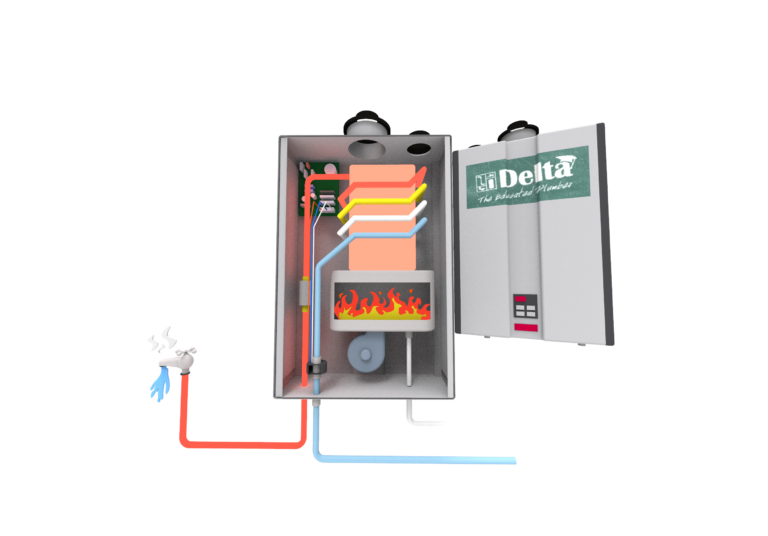
Tankless water heaters heat water instantly as it flows through a compact heat exchanger, so you only use energy when you need hot water — no standby heat loss from a storage tank. This guide walks Atlanta homeowners through the real-world choices: how on-demand systems work, what drives installation cost, and how to pick between gas and electric models. If you want reliable hot water for simultaneous showers and appliances while cutting energy bills, we’ll cover sizing, venting and gas-line issues common to local homes. Read on for typical Atlanta cost ranges, what to expect during installation, routine maintenance like descaling, and troubleshooting tips to keep a tankless unit running for years. The sections below break down costs with sample scenarios, show energy-savings estimates, compare gas vs. electric, outline Delta Plumbing’s installation process, and explain why homeowners in Metro Atlanta choose Delta for installs and ongoing service.
How Much Does Tankless Water Heater Installation Cost in Atlanta?
Installed prices in Atlanta vary based on unit type, capacity and the work required at your home. A full price typically covers the unit, labor, any gas-line or electrical upgrades, ventilation for gas units, and permit/inspection fees. The big cost drivers are the unit brand and BTU/GPM capacity, venting or flue complexity, and whether you need a gas-line or panel upgrade. Below is a clear breakdown of common cost drivers so you can plan a realistic budget before scheduling an on-site estimate.
Next you’ll find an itemized look at typical cost components and example scenarios that reflect common conditions across Atlanta neighborhoods — helpful when comparing contractor quotes.
What Factors Influence Tankless Water Heater Installation Prices?
A few specific items determine the final price. Unit cost varies by brand and output: high-BTU gas condensing models cost more than basic electric point-of-use units, and commercial-grade systems carry a premium. Installation complexity rises when gas-line upgrades, long vent runs, masonry work, or electrical panel upgrades are needed for high-capacity electric units. Permits and municipal inspections add predictable administrative fees, and labor reflects local market rates and any specialty trades (roof penetrations, chimney work, etc.). Knowing these factors ahead of time makes it easier to understand a line-item estimate.
Below is a straightforward comparison of the most common cost drivers so you can weigh tradeoffs before requesting a formal estimate.
| Component | Typical Role | Typical Installed Cost Impact |
|---|---|---|
| Gas tankless unit | Primary whole-house unit purchase | $3,000 – $6,000 (higher-BTU models toward the top end) |
| Electric tankless unit | Unit purchase (point-of-use or whole-house) | $800 – $2,500 (depends on point-of-use vs. whole-house) |
| Gas-line upgrade | Required when existing supply is undersized | $500 – $2,000+ depending on distance and materials |
| Venting system | Forced/condensing venting for gas units | $300 – $1,500 depending on type and run length |
| Permits & inspections | Local code compliance and approvals | $50 – $400 depending on jurisdiction |
This table shows how individual choices and site conditions add to the installed cost, so an on-site evaluation produces the most accurate quote.
How Does Delta Plumbing Ensure Transparent Pricing for Atlanta Customers?
We provide clear, line-item estimates and explain each cost driver so you know what you’re paying for. Our technicians perform an in-person assessment before delivering a written quote, documenting whether a gas-line upgrade, venting modification, or electrical work is needed and why. Because hidden site conditions can change scope, our assessment flags potential add-ons up front and explains permit and inspection requirements so you can compare options with confidence. Atlanta homeowners who request an estimate get a transparent breakdown that helps balance upfront cost with long-term operating savings.
That transparent estimate process cuts down surprises during installation and outlines the next steps: securing permits and coordinating any required trades.
What Are the Key Benefits of Installing a Tankless Water Heater in Atlanta Homes?
Tankless water heaters provide continuous hot water by heating flowing water on demand, eliminating standby losses from a storage tank. That on-demand approach often delivers real energy-efficiency gains because you only heat water when you need it. Homeowners also gain space savings from a compact unit, typically longer service life than tanks, and a lower risk of catastrophic tank leaks. In Atlanta, where many homes need reliable simultaneous hot water and moderate temperature rise, on-demand systems are an attractive upgrade.
Knowing how on-demand heating translates into energy savings and longer equipment life helps homeowners evaluate payback and functional value for their household.
- Benefits include better energy efficiency, continuous hot water, compact footprint, and lower leak risk.
- Tankless systems generally last longer than storage tanks, reducing replacement frequency.
- Compact units free up utility-room or garage space and simplify renovation plans.
Those advantages lead into sizing considerations that determine whether a tankless system will meet your household’s simultaneous demand.
How Does a Tankless Water Heater Provide Endless Hot Water on Demand?
Tankless units heat incoming cold water instantly by passing it through a high-efficiency heat exchanger controlled by flow sensors and modulating burners or electric elements. The unit’s flow rate (GPM) and the required temperature rise determine whether one unit can supply several fixtures at once. For reference, a typical shower uses about 2.5 GPM and a dishwasher roughly 1.5 GPM; sizing to meet combined peak GPM and Atlanta’s incoming water temperature ensures steady delivery. Proper sizing avoids temperature dips or reduced flow — an undersized unit will drop temperature or throttle flow, so accurate peak-load calculations matter.
Sizing ties directly to expected energy savings and the ROI examples that follow for Atlanta homeowners.
What Energy Savings Can Atlanta Homeowners Expect from Tankless Water Heaters?
Studies and guidance show tankless systems can save energy by eliminating standby losses; typical household savings depend on usage patterns and fuel type. Industry estimates (including Energy.gov) suggest reductions often in the 20–34% range for households with lower to moderate hot-water demand, though results vary by climate and how the system replaces an existing tank. As an example: if you spend $500 a year on water heating with a storage tank, a tankless system might cut that bill by roughly $100–$170 annually under typical usage, shortening payback over several years depending on installation premium.
Putting these numbers into an ROI framework helps homeowners weigh upfront investment against long-term operating savings and decide if financing or phased upgrades make sense.
Tankless Water Heater Technology: Energy Efficiency and Mitigation of Standby Heat Losses
Tankless water heaters have been widely adopted in parts of Europe and Japan to lower the energy needed for steady hot-water supply. Because these systems eliminate a storage tank, they remove standby heat losses and can cut water-heating energy use by roughly 25 percent compared with conventional tank heaters.
Demonstration of Tankless Water Heaters in Army Family Housing, 1992
Gas vs. Electric Tankless Water Heater Installation: Which Is Best for Your Atlanta Home?
The right choice between gas and electric depends on your household’s hot-water demand, existing infrastructure, and how much work you’re willing to do during installation. Gas models usually provide higher continuous GPM and better simultaneous-use performance for multi-bath homes, but they require venting and might need a gas-line upgrade. Electric units avoid combustion and venting issues, making them simpler to install where electrical capacity allows; however, whole-house electric models can require significant panel upgrades. Use the checklist and comparison below to match your home’s profile to the fuel type that best balances performance and cost.
Below is a clear comparison of the key tradeoffs between gas and electric tankless installations to help guide your decision.
| Fuel Type | Key Attribute | Typical Impact |
|---|---|---|
| Gas | Higher BTU input & greater continuous GPM | Better for multi-bath or high-demand homes |
| Electric | Simpler install & no venting | Ideal for point-of-use or smaller households |
| Gas | Requires venting and possible line upgrades | Increases installation complexity and cost |
| Electric | May need panel upgrades for whole-house systems | Adds electrical upgrade cost for high-capacity units |
This side-by-side view clarifies tradeoffs so you can decide which fuel best matches your home’s infrastructure and hot-water needs.
- Estimate household peak GPM and simultaneous fixture use.
- Confirm whether you have existing gas service and viable venting routes.
- Verify electrical panel capacity for whole-house electric models.
These steps help homeowners choose a fuel type before scheduling a sizing consultation with an installer.
What Are the Advantages of Gas Tankless Water Heater Installation?
Gas tankless systems deliver higher BTU inputs and usually support greater continuous flow rates, making them a strong choice for larger families or houses with multiple simultaneous hot-water uses. Modulating burners help maintain temperature under heavy loads better than many electric options. Installation requires proper venting (direct vent, power vent, or concentric) and confirmation that your gas service can supply the needed BTUs — otherwise a gas-line upgrade will be required. The higher upfront cost for venting and gas-line work is often offset by better peak performance in multi-bath homes.
Knowing vent and gas-line requirements up front helps you compare realistic quotes and pick a model that balances output with installation complexity.
When Should You Choose Electric Tankless Water Heater Installation?
Electric tankless units are a great fit for smaller households, point-of-use installs, or homes without natural gas service. They remove combustion and venting concerns and are compact and modular for tight retrofit spaces. That said, whole-house electric models need a lot of amperage and may require a panel upgrade, which raises cost. If your peak hot-water needs are modest and your electrical capacity is sufficient, an electric tankless offers a low-maintenance, straightforward option.
Understanding these tradeoffs points to the next step: how an installer determines correct sizing and what to expect during a professional install.
What Is the Tankless Water Heater Installation Process with Delta Plumbing in Atlanta?
Our installation process starts with a detailed consultation to define peak GPM, incoming water temperature and preferred unit location, then moves through site prep, permit procurement, installation, testing and customer handoff. Delta Plumbing’s certified technicians perform sizing calculations and recommend BTU or kW specifications, documenting deliverables and any needed upgrades. During site prep we assess gas-line capacity, venting routes and electrical panel limits, take care of permits and inspections, and schedule installation with a clear timeline. After installation our techs commission the unit, run diagnostics, and leave you with operation instructions and a maintenance plan.
Below is a concise table that describes the deliverables you receive at each phase so expectations are clear before you schedule an on-site visit.
| Service Phase | Deliverable | Customer Outcome |
|---|---|---|
| Sizing Consultation | Recommended GPM and BTU/kW | Right-sized unit selection and quote clarity |
| Site Assessment | Gas, venting, electrical checklist | Transparent scope and upgrade identification |
| Installation & Commissioning | Installed unit with testing & error-code verification | Operational performance with documented tests |
Our stepwise process reduces surprises by combining technical assessment, code compliance and post-installation testing — setting the stage for reliable, long-term performance.
- Initial sizing and scope identification.
- Permit coordination and site preparation.
- Professional installation, testing, and homeowner orientation.
These steps set realistic timelines and outline permit requirements Atlanta homeowners should plan for when scheduling work.
How Do We Determine the Right Tankless Water Heater Size for Your Home?
Sizing starts by adding peak fixture flow rates to get required peak GPM, then calculating the temperature rise based on local incoming water temperature; the installer matches that to a unit’s BTU or kW capacity. For example, two simultaneous showers generally need about 5.0–6.0 GPM; using Atlanta’s average incoming water temp, our technicians calculate the BTU input needed to hold a stable delivery temperature. We document those calculations so you see exactly how a recommended model meets peak demand and efficiency goals. Accurate sizing prevents undersized units (low flow or temperature drop) and avoids oversizing that raises cost without benefit.
That’s why an on-site measurement and calculation are essential before finalizing a model choice.
What Are the Gas Line and Venting Requirements for Installation?
Gas-line needs depend on the unit’s input BTU and the distance from the meter; installers check pipe sizing and pressure to determine if upgrades are required to meet code and performance. Venting options — direct vent, power vent or concentric — depend on unit type and building constraints; condensing units often use PVC for low-temperature exhaust while non-condensing models require stainless or Class A venting. Permits and inspections ensure vent penetrations, clearances and combustion air meet local code, and installers document vent routes and termination locations to avoid rework. Spotting signs of needed upgrades — undersized lines or restricted vent access — helps homeowners anticipate realistic upgrade estimates.
This technical detail prepares you for the types of line items you’ll see on a transparent estimate.
How Do You Maintain and Repair Your Tankless Water Heater in Atlanta?
Regular maintenance keeps the heat exchanger efficient and prevents premature failures: annual descaling and filter cleaning are standard recommendations where water hardness or particulates are present. Homeowners can perform simple tasks like checking inlet screens and following manufacturer flush instructions, but full descaling (pump and chemical solution) or persistent error-code troubleshooting should be handled by certified technicians. Delta Plumbing provides maintenance and repair services including diagnostics, descaling and parts replacement; when scaling or component wear shows up, professional service restores efficiency and extends unit life. A predictable maintenance schedule reduces emergency repairs and preserves energy savings over time.
Knowing common symptoms and maintenance triggers helps homeowners schedule service before small issues become costly.
Why Is Annual Descaling Important for Tankless Water Heaters?
Scale on heat-exchanger surfaces reduces thermal transfer and restricts flow, forcing the unit to run longer and accelerating wear. In areas with moderate to high hardness, annual descaling — or more often if hardness is high — keeps flow rates nominal and prevents error codes tied to overheating or poor heat transfer. Professional descaling removes deposits from internal passages and restores performance; neglect speeds corrosion and can violate manufacturer maintenance recommendations. Signs like fluctuating temperatures, longer recovery times or recurring scale-related error codes indicate it’s time to schedule descaling.
Keeping a regular descaling schedule preserves energy savings and lowers the chance of expensive repairs down the road.
What Are Common Tankless Water Heater Problems and How Are They Fixed?
- Low hot water flow → Often scale buildup or an undersized unit; clean the inlet screen and schedule descaling.
- Intermittent ignition → Possible low gas pressure or vent restriction; check supply and call a technician for pressure testing.
- Error codes displayed → Sensor, flow-sensor or control issues; record the code and contact service for diagnostics.
Put safety first: shut down any unit showing combustion problems and call a certified technician to evaluate gas or venting faults.
Why Choose Delta Plumbing for Your Tankless Water Heater Installation in Atlanta?
Delta Plumbing is a local expert in Metro Atlanta with decades of regional experience and a focus on clear communication, certified workmanship and responsive service. Serving the area since 1974, we call ourselves The Educated Plumber™ — licensed, certified and insured technicians who practice transparent pricing and documented installation processes. We offer 24-hour emergency service for urgent plumbing needs and provide written estimates that spell out permit, gas-line and venting costs before work begins. Homeowners in Atlanta and nearby communities like Stockbridge trust Delta for precise, line-item quotes and reliable follow-through.
Those service attributes reduce buyer uncertainty and make it straightforward to move from evaluation to scheduling a professional install.
How Does Over 50 Years of Experience Benefit Your Installation?
Decades of local work mean we’re familiar with common Atlanta home layouts, typical venting obstacles and municipal permit processes — which cuts down inspection delays and reduces the chance of rework. Experienced technicians spot common patterns, such as undersized gas lines or attic venting constraints, and recommend practical solutions that stay code-compliant without adding unnecessary cost. That institutional knowledge speeds site assessment and installation and eases coordination with inspectors and other trades. Working with a provider who knows the local building stock gives you more accurate timelines and fewer surprises.
This operational experience results in more accurate estimates and fewer delays during permit and inspection stages.
What Certifications and Warranties Does Delta Plumbing Offer?
Delta Plumbing employs certified, licensed and insured plumbers — a combination that signals technical training, regulatory compliance and liability protection for customers. We stand behind our work with service warranties and post-installation support; as one example, Delta offers a three-year warranty on septic services. We also provide maintenance plans and will document warranty terms and coverage during the estimate. Ask for written warranty and service details so you understand scope and any manufacturer obligations after installation.
Clear warranty and certification information helps homeowners compare providers based on predictable aftercare and documented service commitments.